Machine learning · Sustainability / 2026
WasteWise
A machine-learning platform helping restaurants predict and reduce food-waste risk before service.
The product
Engineering clarity
into complexity.
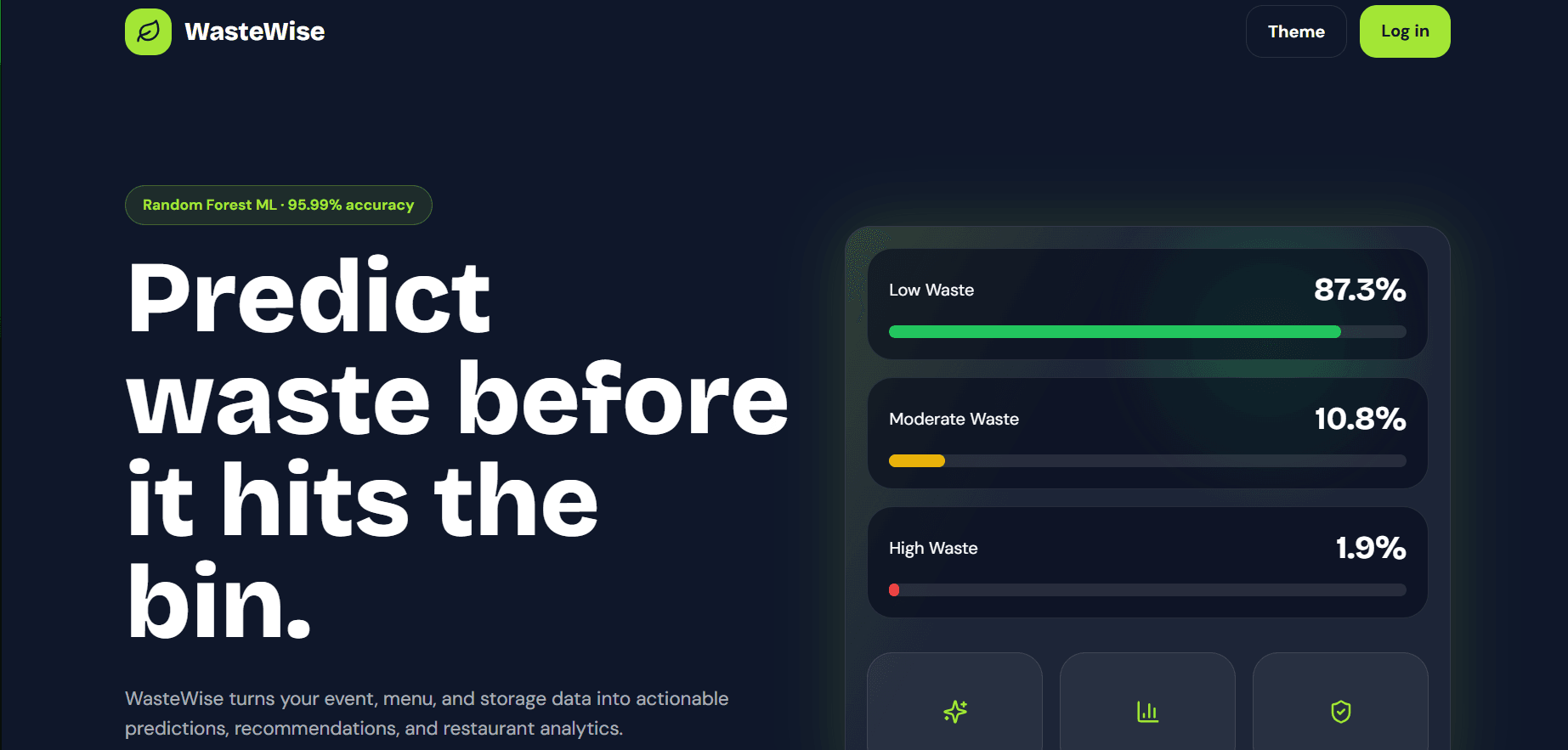
WasteWise translates restaurant and event factors into an actionable Low, Moderate or High waste-risk forecast. The experience combines confidence-aware predictions, personalized recommendations, history and analytics.
- Balanced Random Forest classification pipeline
- Confidence scores and per-class probability distribution
- Personalized reduction recommendations
- Interactive operational and seasonal analytics
01 / The challenge
The problem behind
the interface.
Restaurant teams need a prediction early enough to change preparation decisions, not another retrospective sustainability dashboard. WasteWise turns operational context into an explainable risk level and practical recommendations.
Project constraints
- Mixed numerical and categorical inputs
- Imbalanced waste-risk classes
- Prediction confidence must remain understandable
- Small-service deployment footprint
- History and analytics must remain user-specific
02 / Architecture
Clear boundaries.
Purposeful layers.
Experience
React prediction journey, history, recommendations and analytics dashboard.
Application
NestJS API for authentication, prediction records and reporting.
Model service
FastAPI endpoint wrapping a serialized scikit-learn preprocessing and Random Forest pipeline.
Data
MongoDB persistence and Docker Compose orchestration for the complete system.
03 / Engineering decisions
Trade-offs made
explicit.
Predict three operational risk bands
Low, Moderate and High are easier to connect to preparation decisions than a raw waste quantity without context.
Package preprocessing with the model
Scaling and one-hot encoding stay identical between training and inference, reducing training-serving skew.
Expose probabilities, not only a label
Confidence and class distribution help users understand borderline predictions and avoid false certainty.
04 / System toolkit
A stack assembled
for the problem.
Every technology earns its place in the architecture. The interactive field represents the system's core building blocks.
05 / Outcomes
What the project
actually delivered.
Delivered
- A containerized React–NestJS–FastAPI product
- Prediction confidence and personalized recommendations
- CSV history export and multi-dimensional analytics
- A class-balanced Random Forest pipeline with 200 trees
Next validation steps
- Publish validation metrics and confusion matrices
- Add drift monitoring and model-version traceability
- Measure actual food-waste reduction with partner restaurants
06 / Product in context