AI · Smart mobility · Real time / 2026
TRAFIQ
An AI-powered traffic intelligence platform detecting collisions across multiple video sources in real time.
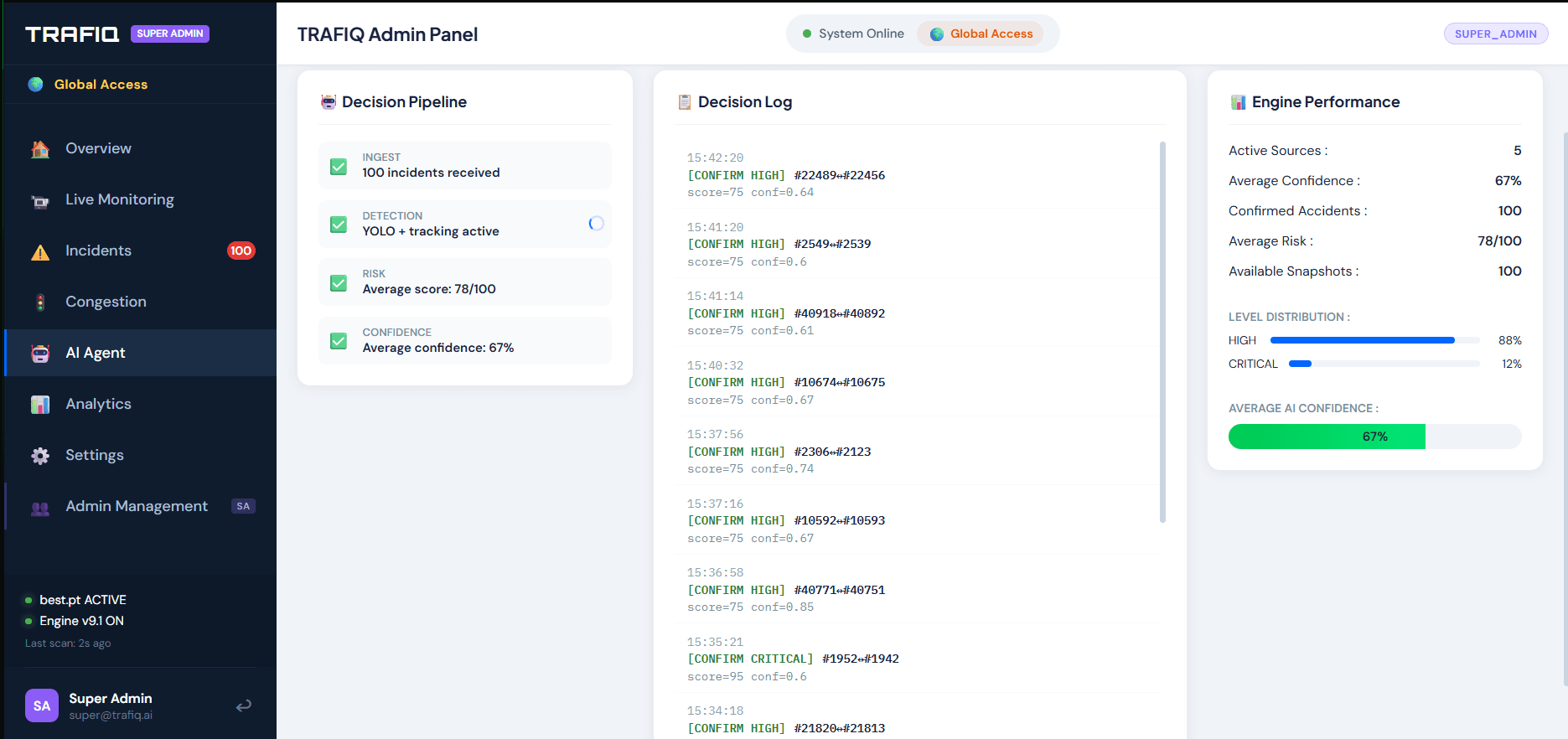
The product
Engineering clarity
into complexity.
TRAFIQ combines a YOLOv8 computer-vision pipeline, authenticated real-time communication and risk-aware navigation in one operational platform. Traffic teams supervise live cameras and incidents while citizens receive contextual alerts and safer route suggestions.
- Multi-camera collision detection with multi-frame confirmation
- Vision-language risk assessment with algorithmic fallback
- Country-scoped RBAC and Redis-backed WebSocket scaling
- CI/CD, observability and Kubernetes deployment foundations
01 / The challenge
The problem behind
the interface.
Traffic operators needed one workflow capable of turning heterogeneous video feeds into trustworthy incidents without overwhelming teams with false positives. Citizens needed the same data translated into understandable alerts and safer routing guidance.
Project constraints
- Local recordings and unstable live HLS sources
- Real-time processing under variable compute resources
- External vision-language service availability
- Country-level access and data isolation
- Evidence preservation for every detected incident
02 / Architecture
Clear boundaries.
Purposeful layers.
Experience
React operator dashboard and public map with live traffic, incidents and routing alerts.
Coordination
NestJS REST and authenticated Socket.IO gateway for commands, events and incident workflows.
Intelligence
Python, YOLOv8 and OpenCV pipeline for tracking, collision confirmation and annotated evidence.
Operations
MongoDB, Redis, Docker, Kubernetes foundations, Prometheus and Grafana.
03 / Engineering decisions
Trade-offs made
explicit.
Confirm across several frames
A single visual overlap is not enough evidence of a collision. Multi-frame confirmation reduces obvious false positives before an incident reaches operators.
Keep a deterministic fallback
Risk scoring remains available when the Groq vision service is unavailable, preventing an external AI dependency from blocking the operational workflow.
Separate operator and citizen contexts
The same incident stream is transformed into two purpose-built products instead of exposing administrative complexity to the public.
04 / System toolkit
A stack assembled
for the problem.
Every technology earns its place in the architecture. The interactive field represents the system's core building blocks.
05 / Outcomes
What the project
actually delivered.
Delivered
- A complete multi-source detection-to-review workflow
- Live congestion and incident updates through authenticated WebSockets
- Country-scoped administration and traceable visual evidence
- A delivery foundation covering testing, monitoring and container deployment
Next validation steps
- Benchmark precision, recall and end-to-end alert latency on a labeled dataset
- Move video ingestion and inference to a queue-backed worker pool
- Run field tests with traffic operators and document alert-fatigue metrics
06 / Product in context
Designed as a system,
not a collection of screens.
07 / Live demonstration